
Famco Chimney Sweep in Wakefield: A Homeowner’s Guide
When a chimney technician specifies a Famco cap or vent component instead of a generic alternative, there’s usually a specific engineering reason behind it: fit tolerance, material gauge, or performance rating. Most homeowners never hear that reasoning. They’re handed a brand name and a price and left to guess whether the part on their flue is the right one. This guide pulls back the curtain on Famco as a brand, where its products show up on Wakefield chimneys, and what questions to ask before anyone installs a component on your home.
A quick working answer up front: Famco is an industry-specified manufacturer of chimney caps, vent hoods, draft inducers, and dampers, and it’s one of the product lines a chimney-only specialist reaches for when a stock hardware-store cap won’t seat correctly or won’t last in freeze-thaw conditions. If you’d rather have a trained eye look at your setup than work through it alone, call (855) 337-2076.
What does Famco actually manufacture for chimneys and vents?
Famco builds venting and chimney components rather than full chimney systems. The category it shows up in most often is caps and top-of-flue terminations, along with vent hoods, draft inducers, and dampers used in ventilation work. In residential chimney service around Wakefield, the pieces you’re most likely to encounter are chimney caps and draft-related components, because those are the parts that sit exposed to weather at the top of the stack.
It helps to understand where each of these fits:
- Chimney caps seat over the flue opening to keep rain, snow, and animals out while allowing exhaust to escape cleanly.
- Draft inducers assist airflow on certain venting setups where natural draft is marginal.
- Dampers regulate how much air moves through the flue when the fireplace isn’t in use.
- Vent hoods terminate venting runs on the exterior of the home.
The reason a chimney specialist cares about which of these is installed, and from whom, is that a cap is not a decorative lid. It’s a fitted termination that has to match your flue’s dimensions and material. A cap that’s slightly too small lets water in at the seam. One that’s oversized can trap moisture or interfere with draft. Famco is specified in professional work because their components are dimensioned for real flue sizes rather than approximated to fit a shelf at a big-box store. If you want the broader picture of what cap and crown work involves on a Wakefield home, our guide to chimney cap & crown walks through it.
Why do chimney specialists use Famco instead of hardware-store caps?
Three practical reasons: fit precision, material durability, and warranty backing. A generic cap is built to a handful of nominal sizes and expected to “work” across many flues. A professional-grade Famco component is built to spec for the flue it’s intended for. On a Wakefield chimney, that difference shows up over years, not days.
Fit precision matters most at installation. A cap has to seat squarely over the flue tile or liner, with a clean lap and no gaps. When the cap is the right size, the installer can secure it properly and move on. When it’s a compromise, the installer has to shim, seal, or force it, and every one of those workarounds is a future leak or a future call-back.
Material durability matters next. Wakefield sits in a climate with genuine freeze-thaw cycles: water gets into a joint or a seam, freezes overnight, expands, and pushes the material apart. A thinner-gauge cap deforms and rusts faster under that cycle. A properly gauged component holds its shape through the seasons.
Warranty backing is the third leg. Reputable manufacturers stand behind their products with defined warranty terms. When a component fails well before it should, having a manufacturer that will back the part matters. Generic hardware-store caps often carry limited or no real warranty once installed.
These are the same reasons we work with a defined roster of industry product lines – DuraFlex liners, HeatShield resurfacing, Gelco caps, Olympia Chimney, and Copperfield – rather than sourcing whatever is nearest. Each brand is specified for a reason.
How does a Famco cap differ from a generic cap on a Wakefield chimney?
A Famco cap is sized to the flue, seated to spec, and rated for the climate. A generic cap is sized to a shelf. On a Wakefield chimney, that gap shows up in three places: the fit at the flue, the way the cap handles freeze-thaw, and how long it actually stays doing its job.
Start with sizing. A proper cap install begins with measuring the flue opening and confirming the liner or tile dimensions. The cap is then chosen to lap correctly over that opening – enough overlap to shed water, enough clearance to allow exhaust. A generic cap forces a “close enough” decision because the sizes don’t line up with real flues. When the install is a compromise, the homeowner inherits the compromise.
Seating is the second difference. A correctly sized cap sits squarely, with an even line all the way around. That even lap is what keeps wind-driven rain and snow out. A cap that’s cocked to one side, or sealed with a bead of caulk to close a gap, is a cap that will fail inside a couple of freeze-thaw seasons.
Long-term performance is the third. Famco caps are built to hold their geometry and finish through temperature swings, so they keep doing what they were installed to do: keep moisture out and exhaust flowing. Over a Wakefield winter, that’s the whole point. A cap that deforms with frost doesn’t shed water the way it did the day it went on.
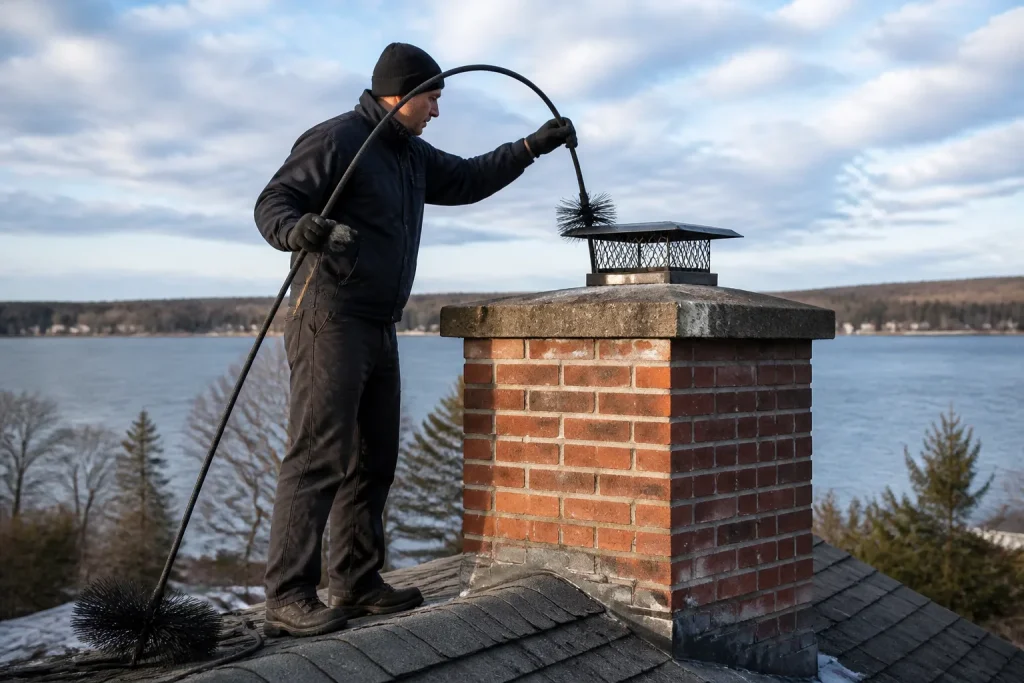
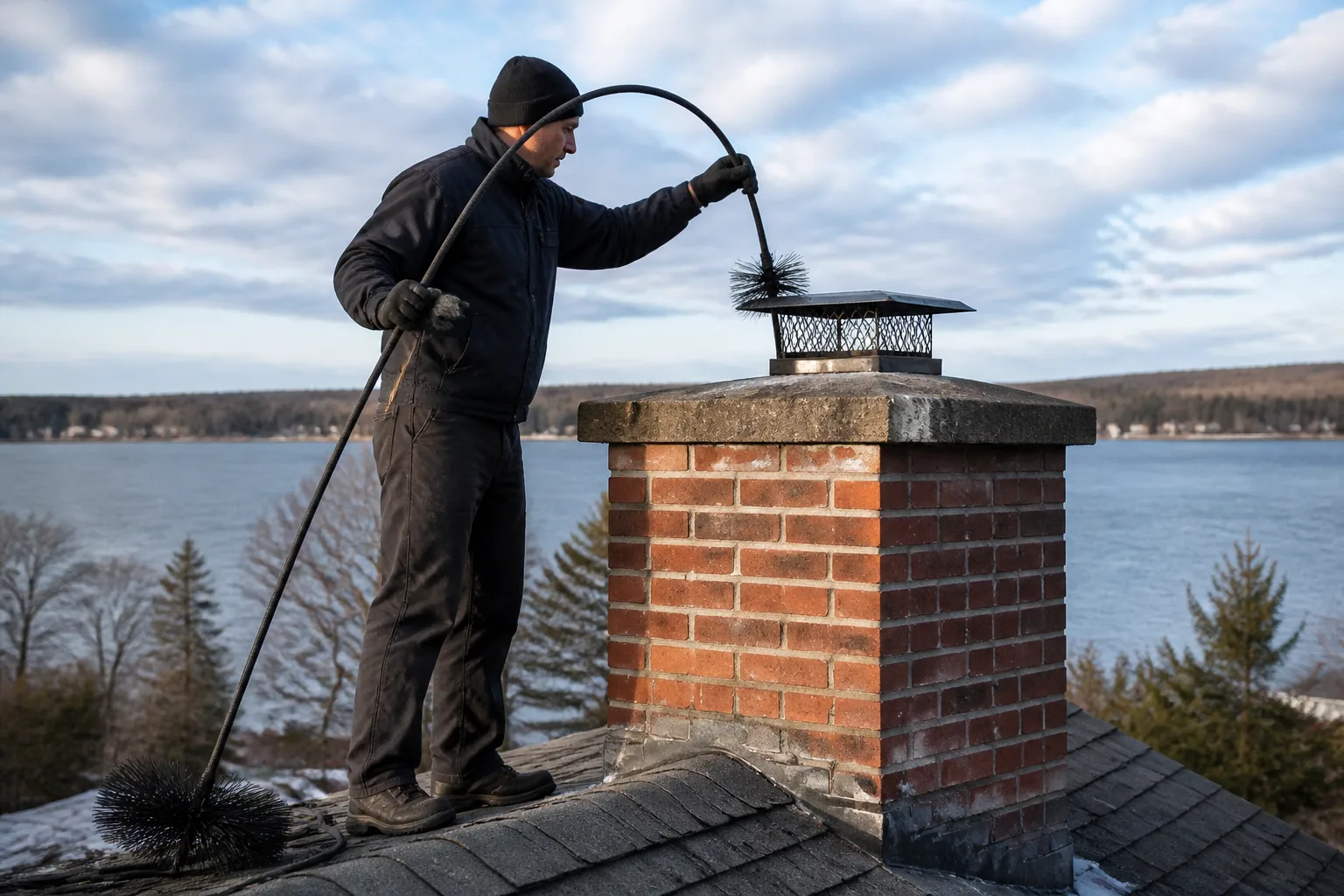
This is the level of detail a chimney-only specialist is set up to handle. Every technician is trained specifically on chimney systems, not plumbing or roofing on the side. When you get a cap recommendation, it comes from someone who installs them for a living, and from a brand built for the job.
What should you ask when a contractor proposes a specific product?
Ask what the product is, why it was chosen for your flue, and how the contractor will verify the fit. Three plain questions will tell you whether the recommendation is grounded in engineering or in whatever happened to be in the truck. A specialist should be able to answer all three without hesitating.
- “What is the actual product and manufacturer?” Get a name, not just “a cap.” If it’s a Famco, Gelco, or Olympia component, that’s a good sign the contractor is working from a defined product line rather than generic hardware.
- “How did you size it for my flue?” A qualified answer references the flue’s measured dimensions and the type of liner or tile in place. A vague answer is a flag.
- “What does the warranty cover?” Look for manufacturer warranty backing on the component itself, separate from any workmanship guarantee the contractor offers.
- “Will you show me the current condition before recommending replacement?” A specialist should be willing to document what’s there – a photo or a look down the flue – before proposing new parts.
A short, honest conversation is worth more than a slick brochure. If a contractor can’t tell you the brand, the size, or the reasoning, the part being proposed deserves a second look.
Why does component quality affect how often you need service?
A properly fitted, professional-grade cap cuts down on the three things that drive unnecessary service calls: blockage, moisture intrusion, and wildlife entry. Most of the “emergency” visits a chimney company makes on Wakefield homes trace back to one of those three problems, and most of those problems trace back to the cap.
Blockage happens when debris, nesting material, or a deformed cap closes off airflow. A cap that fits well and holds its shape doesn’t give wildlife a route in and doesn’t sag into the flue opening.
Moisture intrusion is the quiet one. Water that gets into a chimney through a failed or ill-fitted cap works on the masonry, the liner, and the firebox over time. By the time the homeowner notices, the repair has usually grown. A correctly sized, well-seated cap sheds water the way it’s supposed to, season after season, which is the difference between a small cap replacement and a much bigger chimney repair later on.
Wildlife entry is the third. Animals find gaps that a properly fitted cap doesn’t leave. A generic or poorly fitted cap invites the problem.
None of this replaces routine sweeping. A Famco cap reduces the frequency of avoidable problems; it doesn’t take the place of an annual chimney sweep and inspection. The two work together. If you’re not sure where your setup stands, this is the moment to book a look.
When to call a pro
If you’re hearing animals in the flue, seeing water stains on the chimney breast or ceiling near the stack, noticing a cap that’s visibly tilted or rusted through, or you simply haven’t had the chimney looked at in a while, that’s the point to call. A trained specialist can tell you in one visit whether the cap is the issue and whether the rest of the system is sound. Our technicians have up to 11 years of experience, and the starting point is always the same: inspect first, then recommend.
The Bottom Line
Famco shows up on Wakefield chimneys for the same reasons a specialist chose it: fit precision for real flue sizes, material that holds up through freeze-thaw, and warranty backing you can rely on. A generic cap is a compromise; a properly specified and seated one is not. If you’re comparing products or contractors, ask what’s being installed, how it was sized, and what backs it up – the answers tell you most of what you need to know.
Wakefield Chimney Sweep Pros is a chimney-only specialist. We handle the full loop from the flue to the crown: sweeping, inspection, cap and crown work, liner resurfacing with HeatShield, masonry repair, and fireplace repair. Every visit starts with a real inspection and photo documentation, so you can see what we see before any recommendation is made.
If you’re in Wakefield and need help, Wakefield Chimney Sweep Pros offers free estimates. Call (855) 337-2076. We answer 24/7. Fast dispatch from 7am to 7pm, Sunday through Friday.
Related services in Wakefield: Wakefield Chimney Sweep Pros for the full range, or a chimney repair if a failed component is already causing trouble.
Frequently Asked Questions
A Famco chimney cap is a flue termination component sized to fit a specific flue opening, built to keep moisture, animals, and debris out while letting exhaust escape. It’s a professional-grade product, not the generic hardware-store style, which matters in Wakefield’s freeze-thaw climate.
For most Wakefield homes, yes – mainly in sizing accuracy and durability. A Famco cap is built to the flue size rather than approximated to a shelf dimension, so it seats squarely and holds its shape through frost cycles. A generic cap is the cheaper route, but it tends to fail sooner and can let moisture in.
You know it’s right when it sits squarely over the flue with an even lap all the way around and no caulk filling a gap. If you can see a tilt, a rusted-through edge, or daylight between the cap and the flue, it needs a look. Call (855) 337-2076 for a free estimate; the inspection is where the answer comes from.
Often, yes. A properly fitted cap reduces blockage, moisture intrusion, and wildlife entry, which are the three most common reasons a Wakefield chimney ends up needing unscheduled work. It doesn’t replace an annual sweep and inspection, but a good cap and routine service together keep small issues from growing into large ones.
Written by the team at Wakefield Chimney Sweep Pros.
Need Chimney Cleaning Help?
Call Wakefield Chimney Sweep Pros - the local pro we connect you with is licensed and insured, here with fast help in Wakefield.
(855) 337-2076